Sequence of returns risk is the danger that poor investment returns happen at the wrong time, especially during the first years of retirement when you are also withdrawing money. Two retirees can experience similar long-term investment returns and still end up with very different results simply because their good and bad years happen in a different order.
You have spent decades saving for retirement.
You contributed to retirement accounts. You invested. You watched the balance grow.
Then retirement finally arrives.
And suddenly the math changes.
You are no longer just putting money into your investments.
You are taking money out.
That seemingly simple change introduces a risk many investors never think about until they are close to retirement: sequence of returns risk.
It can help explain why the first few years of retirement can have an outsized effect on how long a portfolio lasts.
And it is also one reason retirement planning is about more than simply asking, “What is my average return?”
What Is Sequence of Returns Risk?
Sequence of returns risk, sometimes called sequence risk, is the risk created by the order in which investment gains and losses occur while an investor is withdrawing money from a portfolio.
A market decline early in retirement can be particularly difficult because the investor may need to sell investments while their values are down in order to cover living expenses.
That means two things are happening at once:
- The portfolio has lost value.
- The retiree is removing additional money from that smaller portfolio.
Once those shares or investments have been sold, they are no longer there to participate in a future market recovery.
That is what makes sequence risk different from simply experiencing normal market volatility.
Retirement Changes the Math: You’re No Longer Just Investing, You’re Withdrawing
During your working years, a market decline can certainly be uncomfortable.
But if you are still earning income, continuing to save, and not relying on your portfolio for everyday expenses, you may have time to wait for markets to recover.
Retirement is different.
Your portfolio may now be helping pay for groceries, travel, housing, healthcare, taxes, hobbies, and everything else your paycheck used to cover.
That can make an early market downturn much more consequential.
Why early retirement losses can hurt more
- Your portfolio falls in value.
- You still need money for living expenses.
- You may have to sell more shares to raise the same amount of cash.
- Those shares are permanently removed from the portfolio.
- Fewer assets remain to participate if markets later recover.
A Simple Sequence of Returns Risk Example
Here's a simplified example.
Imagine two retirees each begin with $500,000.
Each withdraws $25,000 at the end of every year.
And both experience the exact same five annual investment returns:
-15%, -10%, +6%, +8%, and +10%.
The only difference is the order in which those returns occur.
| Year | Retiree A | Retiree B |
|---|---|---|
| 1 | -15% | +10% |
| 2 | -10% | +8% |
| 3 | +6% | +6% |
| 4 | +8% | -10% |
| 5 | +10% | -15% |
| Approximate balance after Year 5 | $339,659 | $374,133 |
They received the exact same five investment returns.
But Retiree A encountered the losses first, when withdrawals were already reducing the portfolio.
Retiree B had positive years first and entered the later downturn with a larger balance.
After just five years, the difference is more than $34,000.
This example is hypothetical and simplified for illustration. It does not include taxes, fees, inflation, dividends, changes in withdrawals, or other real-world factors.
But it demonstrates the basic idea:
When you are withdrawing money, the order of investment returns can matter almost as much as the returns themselves.
Why Is Sequence Risk Especially Important Near Retirement?
Someone who experiences a major downturn at age 35 may have decades of earnings and contributions ahead of them.
Someone who experiences that same downturn shortly after retiring may be in a very different position.
They may no longer have employment income replacing what they withdraw.
And their retirement savings may need to fund decades of future expenses.
Charles Schwab's 2026 retirement research highlights exactly this issue: a significant market decline during the early years of retirement, combined with ongoing withdrawals, can leave a retiree with fewer assets available to benefit from later recoveries.
BlackRock similarly identifies sequence of returns risk as an important consideration when investors move from accumulating wealth to drawing income from it.
Sequence Risk Is Not the Same as Market Risk
The two are connected, but they are not identical.
Market Risk
The possibility that investments decline in value because of changing market conditions.
Sequence Risk
The possibility that those declines occur at an especially damaging time while the investor is also withdrawing money.
A retiree can experience both at the same time.
That is why retirement planning often focuses not only on long-term growth, but also on where retirement income will come from during difficult markets.
What Can Investors Do About Sequence of Returns Risk?
There is no strategy that completely eliminates investment risk.
But investors approaching retirement can plan for the possibility that markets will not cooperate during the exact years they retire.
Common approaches discussed by retirement professionals include:
- Keeping an appropriate cash reserve
- Holding lower-volatility assets for near-term expenses
- Maintaining a diversified portfolio
- Adjusting withdrawals during prolonged market downturns
- Creating multiple sources of retirement income
- Avoiding unnecessary forced sales during major market declines when possible
- Planning spending with flexibility instead of assuming every year will look the same
Schwab, Fidelity, and other retirement researchers frequently discuss cash reserves, spending flexibility, bonds, and income-producing investments as tools investors may consider when building a retirement withdrawal strategy.
The appropriate mix depends on the investor's circumstances, expenses, time horizon, tax situation, risk tolerance, and other income sources.
Where Do Income-Producing Investments Fit?
This is where the conversation becomes especially relevant to NoteSchool.
One way investors think about retirement is through assets that may generate cash flow while they continue to own them.
Different investments can produce income in different ways.
| Investment | Potential Source of Income |
|---|---|
| Dividend-paying stocks | Company dividends |
| Bonds | Interest payments |
| Rental property | Tenant rent |
| REITs | Distributions from real estate operations |
| Performing mortgage notes | Borrower principal and interest payments |
None of these income sources is guaranteed.
Dividend payments can change. Bonds carry credit and interest-rate risk. Rentals can experience vacancies and unexpected expenses. Mortgage-note borrowers can stop paying.
But understanding where cash flow comes from can help investors think more clearly about how a retirement portfolio may eventually support withdrawals.
Do Mortgage Notes Eliminate Sequence of Returns Risk?
No.
Mortgage notes should not be presented as a cure for sequence risk or as a replacement for a complete retirement plan.
They are simply another type of income-producing investment some investors choose to learn about.
A performing mortgage note is built around a contractual stream of borrower payments.
Instead of owning the house, the note investor owns an interest in the debt secured by the real estate.
If the borrower continues paying according to the loan terms, the note holder may receive principal and interest payments.
But notes have their own risks, including:
- Borrower default
- Prepayment
- Property-value changes
- Document or lien problems
- Servicing issues
- Liquidity limitations
- Legal and foreclosure costs in distressed situations
That is why NoteSchool emphasizes learning how to evaluate the note, borrower, property, documentation, servicing, and possible exit strategies before investing.
If mortgage notes are completely new to you, start with our guide explaining how investing in mortgage notes works.
A Real Retirement Example: Tom Force's “Check-a-Day Club”
Tom wanted retirement income without creating another full-time job.
After 43 years as an American Airlines captain, Tom Force was preparing for retirement.
He and his wife had experience with traditional real estate, including house flipping, but he knew that was not how he wanted to spend retirement.
“I want to hang out with the grandkids and play golf and travel and do all that kind of stuff, not be flipping homes.”
Tom wanted cash flow while reducing the hands-on work associated with his previous real estate strategies.
Through NoteSchool, he focused on performing mortgage notes and built a portfolio he jokingly called his “Check-a-Day Club.”
His goal was roughly 30 performing notes.
Tom also brought something important from his aviation career into note investing: risk management.
He reviewed payment histories, servicing notes, property information, and other factors before deciding whether a note fit his portfolio.
Tom's results are his own and should not be interpreted as a guarantee of income or investment performance.
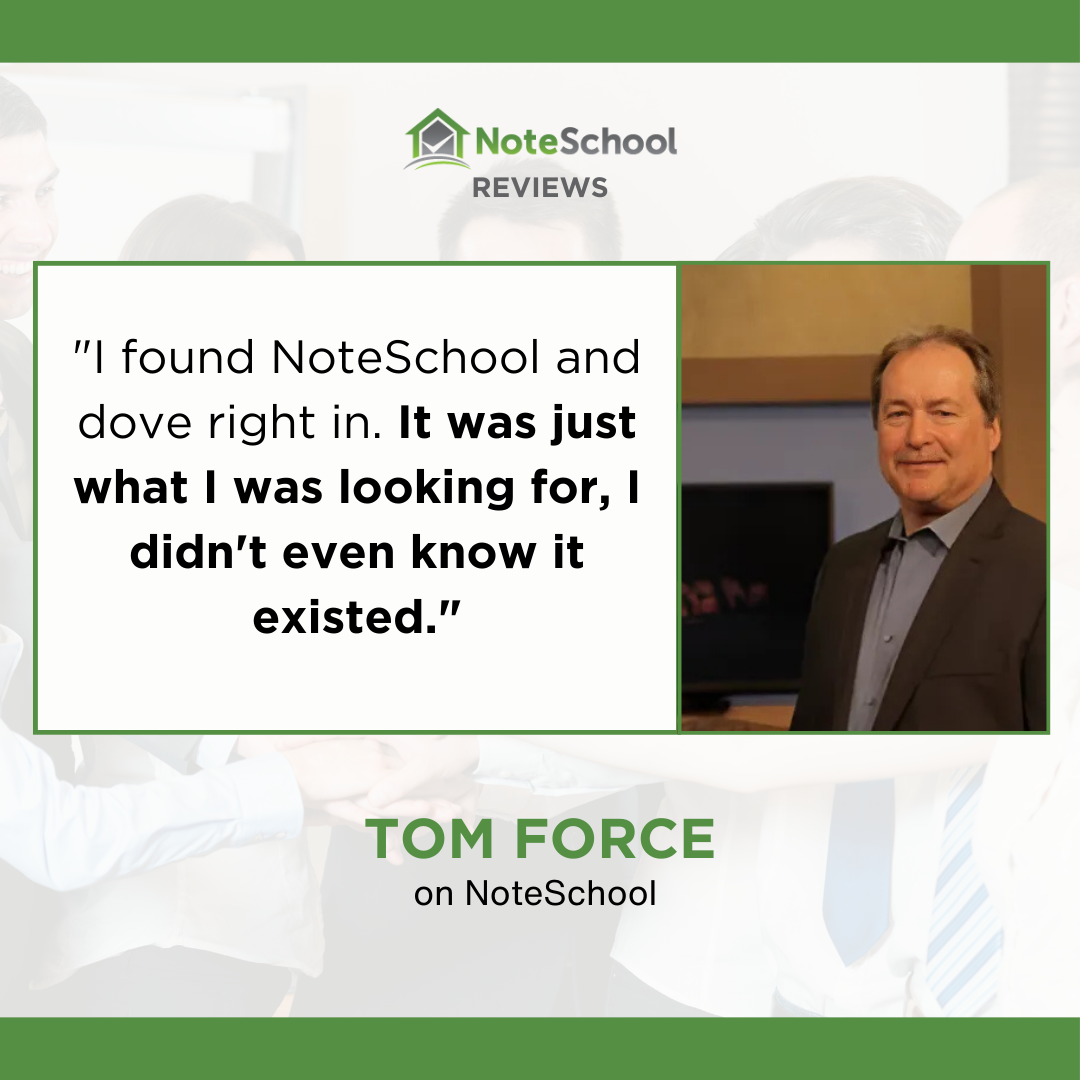
Tom Force used performing mortgage notes as part of the retirement-income strategy he built before leaving his airline career.
Retirement Can Sneak Up on Successful People Too
One of the most useful lessons from NoteSchool student Ann Morton's story has almost nothing to do with investment returns.
Ann had spent more than two decades building a successful real estate career.
But she and her husband eventually realized that professional success and retirement preparation were not necessarily the same thing.
“Being in the industry that I'm in, I work with a lot of people who innocently just don't prepare for retirement, and it just sneaks up on you.”
Ann was self-employed, while her husband's small-company job did not provide a retirement plan.
They had already explored rental properties and other financial strategies before Ann discovered mortgage-note investing.
She eventually began building note income and reconsidering whether she wanted to continue owning all of her rental properties.
Her experience does not prove that notes are right for every retiree.
It does illustrate a larger point:
Retirement planning is easier when you begin thinking about income before the paycheck stops.
Read Ann Morton's full retirement and note investing story →
Growth and Income Are Two Different Questions
Investors often spend their working years asking:
“How much can this investment grow?”
As retirement gets closer, another question becomes increasingly important:
“How will I turn my assets into spendable income?”
Those are related questions, but they are not the same question.
A portfolio can look impressive on paper while still requiring the retiree to decide when and how much to sell.
Income-producing assets offer another way to think about part of that equation.
Again, that does not make them inherently better.
It simply means the investor may receive some cash flow from the asset itself rather than relying exclusively on selling the asset.
Questions to Ask Before You Retire
You do not need to predict the next bear market.
You need a plan that recognizes one could happen.
If retirement is getting closer, these questions are worth discussing with your financial and tax professionals:
| Question | Why It Matters |
|---|---|
| How much will I actually need to withdraw each year? | Your required withdrawals determine how dependent you are on investment sales and portfolio income. |
| Which expenses are essential? | Knowing which spending can be reduced during difficult markets may provide flexibility. |
| How much liquid cash will I have? | Liquidity can help cover near-term expenses without immediately selling longer-term investments. |
| What income will I receive outside my portfolio? | Social Security, pensions, employment, rental income, and other sources can change how much must come from investments. |
| What happens if markets fall immediately after I retire? | This is the core sequence-of-returns question. |
| Am I relying entirely on selling assets for income? | Some investors choose to explore income-producing assets as one component of a broader retirement strategy. |
| How liquid are my investments? | Not every investment can be sold quickly or at the price you expect. This is especially important with private investments and mortgage notes. |
Don't Chase Yield Just Because You're Retiring
There is another side to the retirement-income conversation.
When investors realize they need cash flow, it can be tempting to simply search for the investment offering the highest yield.
That can create a completely different problem.
Higher stated returns can come with higher credit risk, liquidity risk, leverage, volatility, complexity, or other risks that may not be obvious at first glance.
Whether you're evaluating bonds, dividend stocks, private credit, rental properties, or mortgage notes, ask:
- Where does the income come from?
- What could interrupt those payments?
- What collateral or assets support the investment?
- How quickly can I access my money?
- What fees and expenses reduce the return?
- What happens in a bad-case scenario?
- Do I actually understand what I own?
Retirement is generally not the time to stop doing due diligence.
It may be when due diligence matters most.
Where Mortgage Notes May Fit Into the Bigger Picture
Mortgage note investing is one part of a much larger retirement and investing landscape.
It does not replace Social Security.
It does not replace cash reserves.
It does not automatically replace stocks, bonds, or other investments.
And it does not guarantee monthly income.
What notes can offer is a different way to look at real estate.
Instead of owning the property and relying on rent or appreciation, note investors learn how to analyze the debt and payment stream attached to the property.
For investors interested in building multiple potential sources of income, that can be worth understanding.
You can also read Virginia Rogers' story to see how one NoteSchool student used performing mortgage notes as part of the income strategy she wanted later in life.
The Bottom Line
Sequence of returns risk is a simple concept with major implications.
A market decline is difficult at any age.
But a decline during the first years of retirement can be particularly damaging when you're also withdrawing money from the portfolio.
That is why retirement planning should go beyond simply estimating an average annual return.
Investors need to think about:
- where retirement income will come from,
- how much liquidity they need,
- how flexible their spending can be,
- what happens during a prolonged market decline, and
- which investments they actually understand.
Mortgage notes are not a cure for sequence risk.
But for investors interested in income-producing assets and the debt side of real estate, they are another strategy worth learning about.
And the best time to understand your options is generally before you need the income.
Frequently Asked Questions About Sequence of Returns Risk
What is sequence of returns risk?
Sequence of returns risk is the risk that poor investment returns occur early in retirement while an investor is also withdrawing money. Early losses combined with withdrawals can leave fewer assets available to participate in future market recoveries.
Why does sequence of returns risk matter more in retirement?
Retirees often rely on their investment portfolios for living expenses. If markets decline while withdrawals continue, they may need to sell more investments at depressed values, reducing the assets available for future growth.
Can two retirees with the same investment returns end up with different amounts of money?
Yes. If the same gains and losses occur in a different order while the retirees are making withdrawals, their ending portfolio values can differ significantly. This is the central idea behind sequence of returns risk.
How can investors prepare for sequence risk?
Strategies commonly discussed by retirement professionals include maintaining appropriate cash reserves, diversifying investments, creating spending flexibility, holding assets intended for near-term expenses, and considering multiple sources of retirement income. The right approach depends on the investor's individual circumstances.
Do income-producing investments reduce sequence of returns risk?
Income-producing investments can provide cash flow that may reduce an investor's need to sell other assets for spending, but they do not eliminate sequence risk or investment risk. Every income-producing asset has its own risks and should be evaluated as part of a broader retirement plan.
Can mortgage notes provide retirement income?
Performing mortgage notes may provide principal and interest payments when borrowers continue paying according to the loan terms. However, notes involve risks including default, prepayment, liquidity limitations, servicing issues, property-value changes, and legal or documentation problems.
Are mortgage notes safer than stocks for retirees?
They are different investments with different risks. Mortgage notes should not automatically be considered safer than stocks or other investments. Investors should evaluate risk, liquidity, expected cash flow, collateral, diversification, and their own financial situation before investing.
When should investors start thinking about sequence of returns risk?
Sequence risk becomes particularly important as investors approach retirement and begin planning portfolio withdrawals. Preparing before retirement can provide more time to establish cash reserves, spending plans, income sources, and an overall withdrawal strategy.
Sources and further reading
- Charles Schwab, January 2026: “What Is Sequence-of-Returns Risk?”
- BlackRock Retirement Perspectives, April 2026: “Will My Income Last a Lifetime?”
- Fidelity Investments: Retirement guidance on sequence-of-returns risk, withdrawal strategies, and retirement income planning.
This article is educational and is not individualized investment, tax, or legal advice. Investment results vary, and all investments involve risk.
Looking for another way to think about retirement income?
New to notes? Start here.
Get 9 free videos that introduce you to mortgage note investing and the debt side of real estate.
No credit card. No pitch. Just straight answers.
- ✓ Learn how mortgage notes and payment streams work
- ✓ See why some investors choose to own the debt instead of the property
- ✓ Understand the basics before deciding whether notes fit your goals